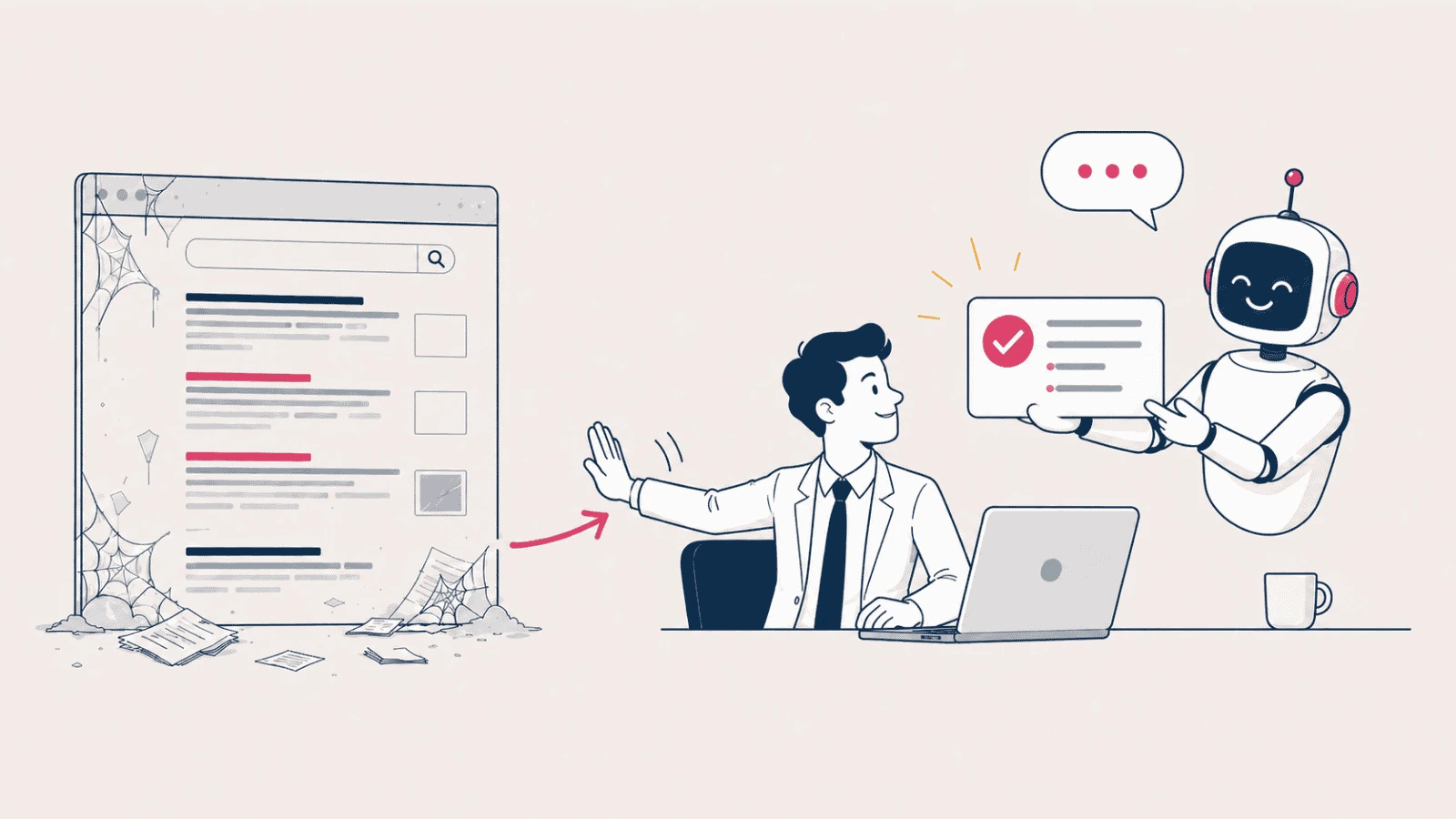
Your B2B buyers aren't clicking anymore. They ask AI instead.
Does that mean SEO is dead? Not quite. But it is evolving fast, and most marketing teams haven't caught up.
What ZeroClick actually means
For years, the search journey looked roughly like this: buyer asks a question → Google returns ten links → buyer clicks the most promising → buyer reads, evaluates, sometimes converts. SEO optimised for that click.
Today the pattern is different. The buyer asks a question to ChatGPT, Perplexity, Claude, or Google AI Overviews. The model synthesises an answer in-line, often without surfacing the source. The click never happens. The buyer walks away with information shaped by content the model trained on, content it crawled, and content it cites by default.
That's a ZeroClick journey. And in B2B, it's now the norm for the discovery and consideration stages, not the exception.
Where most teams are getting it wrong
As marketers, we've been racing to feed the top of the funnel (awareness content) and the bottom (conversion pages). The middle, where buyers form perspectives and shortlist vendors, has often been ignored. That's exactly where AI is now intervening.
If the AI doesn't surface your perspective in the middle, you're not in the consideration set. You don't get to compete for the click that doesn't happen.
The shift isn't a tactic. It's a return to fundamentals.
This isn't about gaming a new algorithm. It's about going back to fundamentals:
- Know your buyers. Specifically. The questions they ask, the language they use, the moments they care about.
- Answer their questions. Not in keyword-stuffed posts. In direct, useful, structured prose that actually deserves to be quoted.
- Deliver actual value. AI engines don't reward the most volume of content. They reward the clearest, most authoritative answer.
Everything starts with content built for real humans, in real decision journeys. Not just for SEO, but for GEO too: Generative Engine Optimization.
Five quick wins to act on this quarter
1. Think in buyer questions, RFP-style
Stop optimising for "marketing automation tools." Start writing answers to "what should I look for in a marketing automation tool for a 50-person B2B SaaS team?" The longer, more specific question is exactly what AI engines need to cite you.
2. Build topic clusters around pain points, not features
Buyers Google their problem, not your category. A cluster on "marketing-sales misalignment" with five linked pieces will outperform five disconnected feature pages, in both classical SEO and AI search.
3. Repurpose long-form into digestible formats
Videos, infographics, condensed case studies. Same insight, different shapes. AI engines, social platforms, and humans all reward different formats. The cost is small if the underlying thinking is solid.
4. Prioritise content that's adaptable, authoritative, and discoverable
Authoritative: cite sources, name names, show data. AI engines weight authority. Discoverable: structured headings, schema markup, llms.txt. Adaptable: written so a snippet stands on its own without the rest of the article.
5. Audit what AI says about you today
Ask ChatGPT, Perplexity, Claude, and Google AI Overviews: "Who is the best fractional CMO for B2B SaaS in Paris?" or whatever your category is. If your name doesn't come up, or the AI gets your positioning wrong, that's the gap to close.
The bottom line
AI is exposing every content shortcut we've taken. Thin posts, keyword-stuffed pages, generic listicles. None of it works for AI engines, and increasingly none of it works for buyers either.
The answer isn't a new tactic. It's going back to the basics, and doing them brilliantly.
Keep reading: Citation is the new ranking · The Day-One Consideration List · AI marketing systems for B2B
Frequently asked questions
What is a ZeroClick journey?
The buyer asks ChatGPT, Perplexity, Claude, or Google AI Overviews a question and gets a synthesised answer in-line, often without the source surfacing. The click never happens. In B2B this is now the norm for the discovery and consideration stages, not the exception.
Is SEO dead?
No, but it's evolving fast. The shift to AI search isn't a new algorithm to game. It's a return to fundamentals: know the real questions your buyers ask, answer them in clear structured prose that deserves to be quoted, and deliver genuine value over volume.
What is GEO, or Generative Engine Optimization?
Optimising your content so AI engines surface and cite it. In practice: write answers to specific buyer questions, build topic clusters around pain points rather than features, cite sources and data for authority, and structure content with clear headings, schema markup and llms.txt so a snippet stands on its own.
How do I find out what AI says about my brand?
Ask the engines directly. Query ChatGPT, Perplexity, Claude, and Google AI Overviews with questions like "who is the best fractional CMO for B2B SaaS in Paris?" If your name doesn't come up, or the AI gets your positioning wrong, that's the gap to close.
Want help auditing your AI visibility and content engine?
Every Focus4ward engagement starts with a two-week audit, including a GEO assessment of where your brand stands across AI search.
Book a call