Where this list comes from
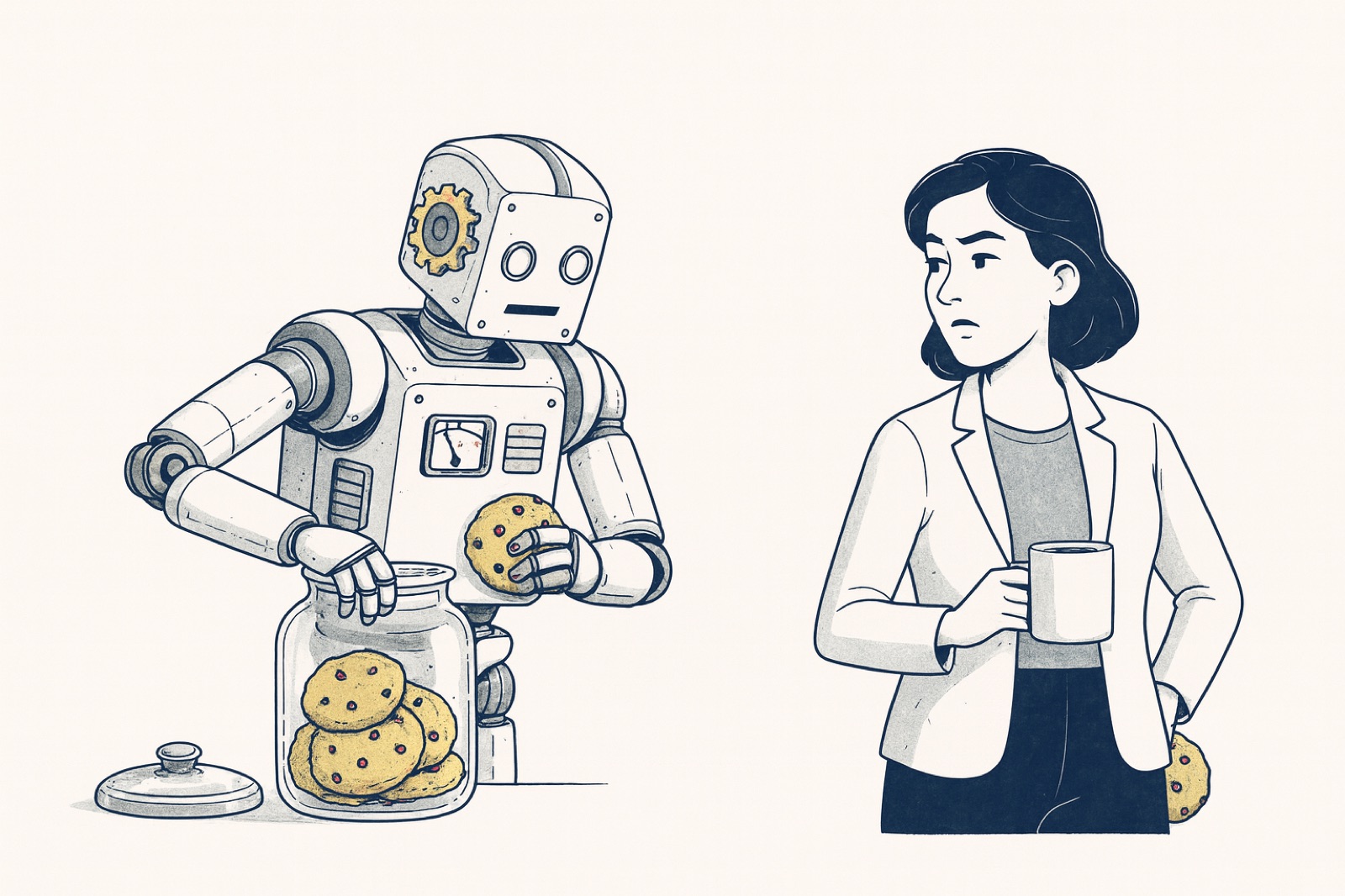
In July I caught my own AI system with its hand in the cookie jar. Four comment drafts, four different topics, one identical skeleton: an observation, a small build, a tidy line to close. Nothing was wrong with any of them, which was exactly the problem. That catch sent me on a full audit of my own website, and the audit turned up shapes in copy I had written myself in 2024, before any machine touched my marketing.
That's the first thing to understand about AI tells: the shapes are older than the models. Copywriters leaned on them for decades because each one works in small doses. AI didn't invent them; it made them free, infinite, and identical across every feed. What five companies used to say badly, five hundred now say badly, in the same week.
The second thing: vocabulary is the tell everyone knows, and the least reliable one. Swap out delve, tapestry and unlock and the copy still reads machine, because the machine is in the structure. The durable tells are shapes.
And the third, the one that matters most before you read the list: none of these is banned. Every shape below is legitimate, once. A single three-item list is rhythm. A single reversal can be an argument. The tell is density. When the same shape recurs through a piece, or two or three of these patterns share one page, the reader's pattern-matcher fires and the word that forms is "generated". Style is a choice made once. A tic is a default repeated.
The twelve tells
1. The rule of three
"Strategy, execution, alignment." Machine lists close at exactly three items, every time, because three feels complete. Real thinking is messier. Sometimes two things matter. Sometimes five do, and one of them is awkward. Count the lists on your page: if every one lands on three, the rhythm isn't yours.
2. The self-answered question
"So what does this actually mean for your team? It means everything." The question nobody asked, answered on the next line. It simulates dialogue without risking one. A person with a point states it; the rhetorical set-up is the model buying itself a transition.
3. The instant profundity
"This isn't a tool. It's a mindset." Something ordinary promoted to profound, on no evidence. The reversal shape can carry a real argument: "not an agency, not a full-time hire" is a genuine positioning claim, and cutting it deletes the case. That's the test. Remove the reversal and check whether the claim still exists. If nothing is lost, it was decoration.
4. The walk-back
"Powerful, yes. A silver bullet, no." The concession that arrives before the claim has even landed. Balance reads as fairness in a debate and as fear in a point of view. Commit to the position; if a caveat is owed, let it come late, from experience, after the argument has stood on its feet.
5. The fragment cascade
"Not louder. Sharper. Every time." Three fragments falling down the page, doing the work one sentence would have done. It photographs well and says little. One fragment lands a punch. A stack of them is drum machine, not drums.
6. The wisdom close
"Because in the end, the best strategy is the one you actually execute." Somebody had to land the plane. A tidy aphorism at the end of every section, each one begging to be screenshotted, is machine rhythm at its purest. One landing line per piece is a choice. Five is a metronome, and readers hear it even when they can't name it.
7. The copy-paste skeleton
Six cards that all read [list] + [fragment]. An essay where every section is a bolded term, a colon, and its explanation. Parallel grammar used once is a tool; as the shape of an entire page it's a stamp, and it's the first thing a scanning eye picks up without knowing why.
8. The hedge stack
"Can often help teams to potentially improve outcomes." Count the softeners piled on that one poor verb. A person with a point commits: this works, do it. Stacked modality is what a model sounds like when it's afraid of being wrong about everything simultaneously.
9. Nothing has a name
No client, no number, no Tuesday, no city. Machine prose speaks in categories: "companies", "teams", "significant results." Human experience arrives with proper nouns attached, because it actually happened to someone. One name, figure, date, or contradictable moment per paragraph is the cheapest authenticity there is.
10. The uniform sentence
Every sentence between fifteen and twenty words, stacked into rectangular paragraphs of nearly equal height. Real writing has a pulse. Some sentences run long because the thought does, winding through a qualification the writer refuses to cut. Some don't.
11. The fake insider
"The part most people skip." "What nobody tells you about positioning." If every post on your feed knows what nobody tells you, somebody is telling it, loudly, at scale. Manufactured scarcity of insight reads as exactly what it is.
12. The unrequested recap
An intro that announces what the piece will cover, a closer that begins "In short" and repeats what it covered. That's the shape of a model managing a context window, not a person talking. Start inside the point. Stop when it's made.
The two tests that catch all twelve
The read-aloud test. Read the piece out loud, at conversational speed, to an empty room. Mark every place your mouth refuses to go: the "moreover", the hedge stack, the sentence you would never say across a table. Your voice knows before your eye does, and most of the tells above disappear in that single rewriting pass.
The mother test. Show the piece to someone who knows how you actually talk. Your mother qualifies. The question is not whether it's good; it's whether she recognises you in it. Text that could have been written by anyone is the tell underneath all the others, and no editing trick fixes it, because the missing ingredient is a point of view.
None of this is an argument against writing with AI. I build AI content systems for a living, and this site runs on one. It is an argument against publishing defaults. A machine with documented voice rules, banned patterns, and real source material writes like its owner. A machine without them writes like every other machine, and in a feed where the engines themselves now choose what to cite, sounding like everyone is the most expensive thing your content can do.
The LinkedIn post that forced this list out of my system goes live today at noon. It had to survive the list first.
Frequently asked questions
What are AI tells in writing?
AI tells are recurring structural patterns that mark a text as machine-written: lists that always close at three items, self-answered rhetorical questions, walk-backs that defuse a claim before it lands, fragment cascades, wisdom closes, stacked hedges, and prose where nothing carries a name, a number, or a date. They are shapes rather than words, which is why grammar checkers miss them and readers feel them anyway. A single instance is style; recurring density is the tell.
Do AI detectors catch these patterns?
Unreliably. Detectors score statistical fingerprints and can be fooled in both directions: human writing gets flagged, edited AI passes. The audience that matters is not a detector, it is a reader who has now seen thousands of machine-shaped posts and pattern-matches in seconds. Write for the reader who smells it, not for the tool.
Should you stop using AI to write content?
No. The tells are not caused by using AI, they are caused by publishing unedited defaults. AI systems built on documented voice rules, banned patterns, and real source material produce content that carries a specific point of view. The fix is a voice system and an editing pass, not abstinence.
What is the fastest way to fix AI-sounding copy?
Read it aloud and mark every sentence your mouth refuses to say naturally. Then add one proper noun, number, or dated moment per paragraph, vary any list that lands on exactly three items, and cut every closing aphorism except the one that earns its place. Those four edits remove most of the machine shape in one pass.
Wondering if your own site would pass this list?
Every Focus4ward engagement starts with an audit, and the voice layer is part of it: which patterns your content leans on, what your buyers actually hear, and the systems that keep your writing yours at scale.
Book a call