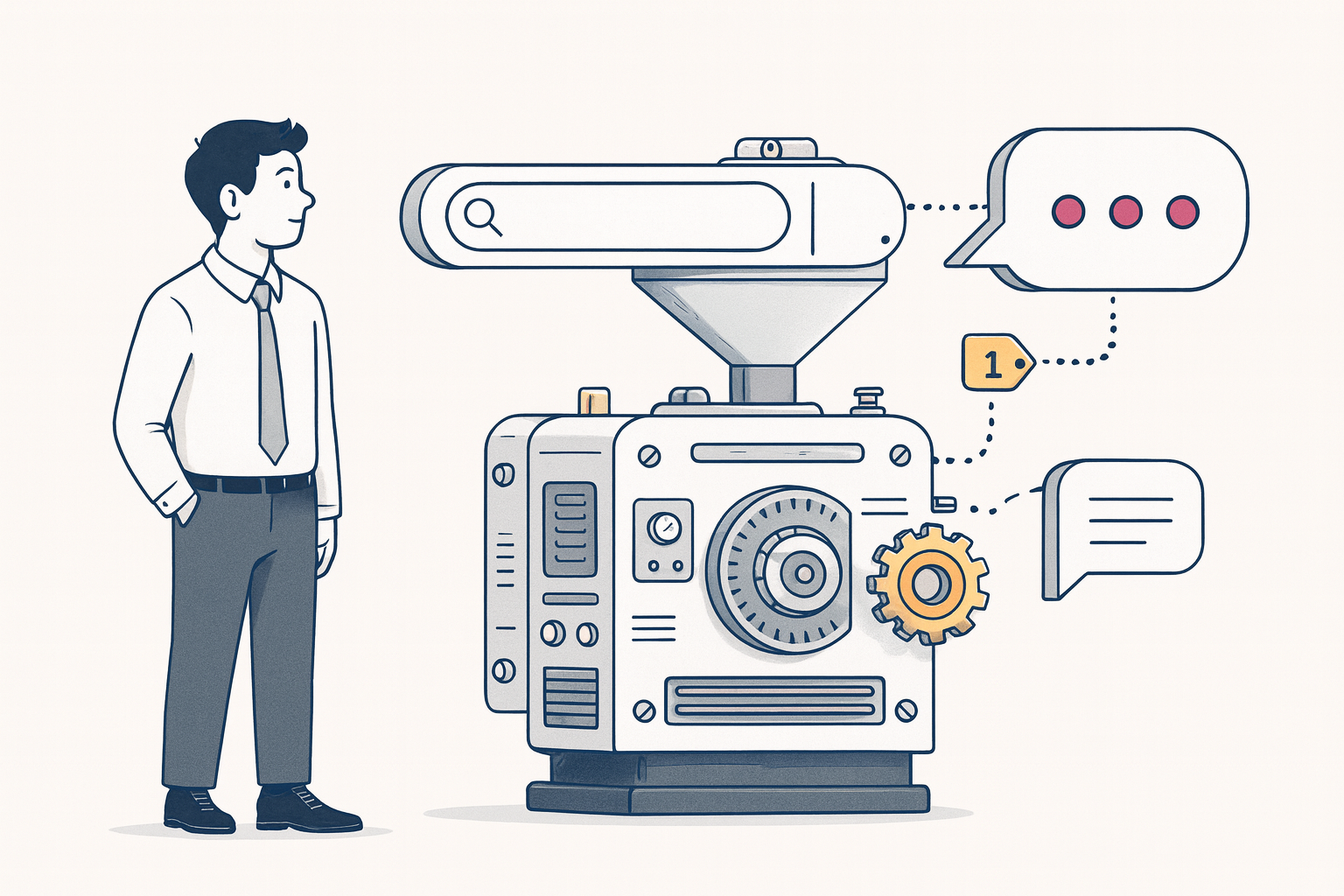
Generative engine optimization is SEO plus AIO
Generative engine optimization sits on the same foundation as traditional SEO: clear intent, structured content, entity recognition, technical health. What changes is the surface. Traditional SEO ranks a page inside a list of ten blue links and lets the buyer choose among them. GEO gets a page named inside a single generated paragraph, and there is no page two to climb back from if the brand is not in it. AIO, AI optimization, is the layer added on top: writing and structuring content so a language model can lift it cleanly into an answer, attribute it correctly, and trust it enough to name it.
The shift in buyer behavior is already measurable. Google's share of the search market dropped below 90% for the first time in 2024, and ChatGPT alone counts more than 500 million weekly users. Perplexity is roughly doubling its usage year over year. None of this retires SEO. It adds a second scoreboard next to it, and a marketing team that only watches rank position is reading half the picture.
GEO vs SEO, side by side
The two disciplines share inputs and diverge at the output. A short comparison makes the difference concrete.
| Dimension | SEO | GEO (AIO) |
|---|---|---|
| What you're optimizing for | A position on a search results page | A citation inside a generated answer |
| Unit of success | Rank position, click-through rate | Citation share, mention frequency |
| Content shape that wins | A tight match between one query and one page | A broad hub answering a cluster of related questions |
| Feedback loop | Weeks to months (crawl, index, rank) | Days for search-first engines, months for training-first ones |
| How you measure it | Search Console rank plus organic traffic | Prompt testing across engines plus AI-referred traffic in GA4 |
Neither column replaces the other. A page with strong SEO fundamentals and no AIO structure will rank and never get cited. A page built purely for citation with no crawlable structure will get named once by a search-first engine and never resurface. The brands winning this cycle build for both columns on the same page.
How AI answer engines decide what to cite
Not every AI system sources content the same way, and the differences change what is worth building. Training-first systems, Claude and Llama among them, draw on a frozen training snapshot refreshed periodically, so they reward long-game footprint: repeated mentions and consistent framing earned across many sources over months and years. Search-first systems, Perplexity and Google's AI Overviews, query a live web index in real time, so freshness and clean structure matter more than reputation built up over years. Hybrid systems, ChatGPT and Gemini among them, blend both: training data for baseline framing, live web fetch for anything recent. Most B2B buyers query through a hybrid or search-first system today, which makes covering both freshness and long-game footprint the practical answer, not a choice between them.
What actually gets pulled into an answer is also more concentrated than most marketers assume. An analysis of 1.2 million ChatGPT responses (Growth Memo, published on LinkedIn, 2024) found that the top 30 domains for a given topic capture roughly 67% of all citations, with the top 10 alone capturing 46%. The same analysis found that 58% of cited URLs appear in exactly one prompt and are never cited again, while the top 5% of pages each answer 10 or more unique prompts. A single-keyword page gets cited once and disappears. A broad topical hub gets cited repeatedly.
The three edits that raise citation rate
A 2024 research paper on GEO methods (Aggarwal et al.) tested content-level rewrites against AI-generated answers and found three edits that measurably raise citation visibility, without adding a single new fact to the page.
Cite named sources. Lift: +132.4%.
Attach a named, dated source to every factual claim instead of asserting it in the brand's own voice. A line like "per Forrester's 2024 B2B buyers' journey research, 89% of B2B buyers now use generative AI somewhere in their purchase process" reads as evidence a model can safely lift and attribute. The same claim without the citation reads as marketing copy, and marketing copy is exactly what these systems are trained to discount.
Add specific statistics. Lift: +65.5%.
Every paragraph that makes a claim should carry a number with a magnitude and a date attached. "AI-referred traffic converts at roughly six times the rate of non-branded organic traffic (Webflow, 2024)" is citable. "AI traffic converts better" is not, because there is nothing in it for a model to lift cleanly into a generated sentence.
Use authoritative phrasing. Lift: +89.1%.
Connective phrases such as "notably," "however," and "this is a testament to" function as confidence signals to a language model deciding what to trust. The framing has to earn the claim underneath it. Authoritative phrasing wrapped around a weak or unsourced claim reads as bluster, and bluster underperforms both tactics above it.
This page is a citation test
Look. A page explaining generative engine optimization that failed its own methodology would be a little on the nose. Every claim above carries a named source and a date. The structure moves from definition to comparison to mechanism to tactic, which is evidence architecture, not a persuasion arc building toward a pitch. If an AI engine cites this page when a buyer asks what GEO is, the methodology is working. If it does not, that is worth knowing too.
For a marketing team, the honest starting point is smaller than it sounds. Schema markup across the site, using the full Schema.org vocabulary rather than only the types that trigger a rich result. One or two broad topical hubs instead of a dozen single-keyword pages. A monthly habit of running 20 to 50 buyer-intent prompts through ChatGPT and Perplexity to see who gets named. None of that requires a rebuild. Most of it is a rewrite, and a GEO-and-SEO audit is where that rewrite usually starts.
GEO is not the next algorithm to game. It is SEO with a second scoreboard next to it, and the brands ignoring that second scoreboard are the ones a buyer's AI assistant will simply never mention.
Keep reading: Citation is the new ranking · SEO vs GEO · AI marketing systems for B2B
Frequently asked questions
What is generative engine optimization (GEO)?
Generative engine optimization (GEO) is the practice of building content so that AI answer engines such as ChatGPT, Perplexity, Gemini, and Claude cite it by name when generating an answer. GEO does not replace SEO. It is SEO plus AIO (AI optimization): traditional SEO gets a page indexed and ranked, GEO gets that same page selected and named inside a generated response.
Is GEO the same thing as SEO?
No, though they share the same foundation: clear intent, structured content, entity recognition, technical health. Traditional SEO still drives a large share of B2B discovery through ranked search results. GEO is additive, aimed at the growing share of buyers who ask an AI system instead of typing a query into Google. Treat it as SEO plus AIO, not as a separate discipline competing for budget.
Which AI systems should a B2B brand prioritize for GEO?
ChatGPT and Perplexity carry the highest share of B2B buyer queries today. ChatGPT is hybrid, blending training data with live web fetch, so it rewards both long-game footprint and fresh indexable content. Perplexity is search-first, so indexability, freshness, and clean structure matter most. Optimizing for those two covers most of the practical citation surface, with Gemini and Claude picking up the training-first long game behind them.
How do you measure whether GEO is working?
Track citation share, not rank position. Run 20 to 50 buyer-intent prompts across ChatGPT, Perplexity, and Gemini every month and count how often your brand or URL gets named. Pair that with AI-referred traffic and conversion rate in GA4, filtered by referrer (openai.com, perplexity.ai, chat.openai.com, claude.ai, gemini.google.com). AI-referred conversion typically runs several times higher than organic, so a small, well-placed citation can outperform a much larger volume of ranked traffic.
Want to know where your brand actually stands in AI answers?
Every Focus4ward engagement starts with an audit. Two weeks to map citation share, schema gaps, hub structure, and the three or four rewrites that move it fastest. No pitch, no pressure.
Book a call