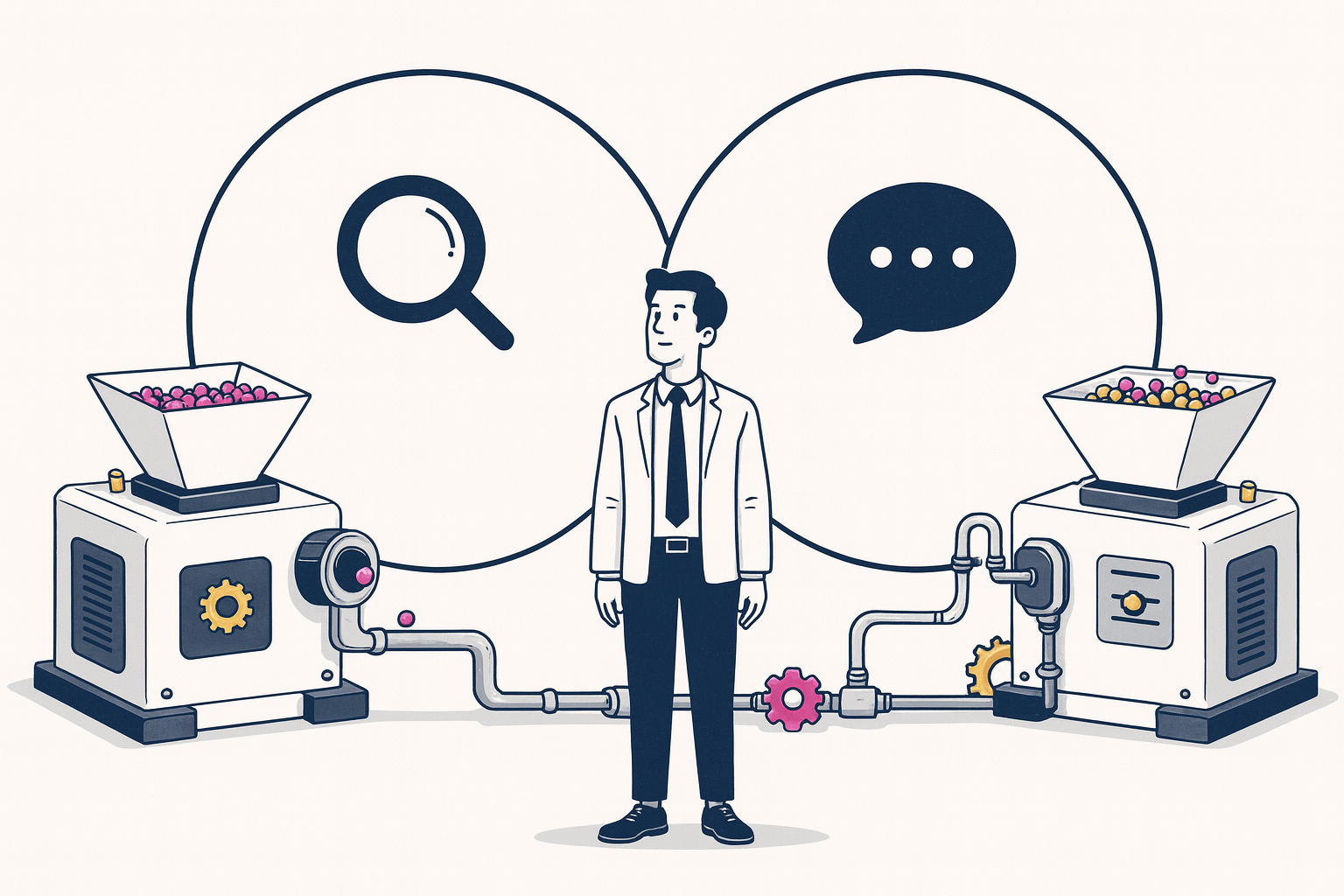
SEO vs GEO: what each one actually optimizes for
Traditional SEO optimizes for a position in a search engine results page. Rank higher, capture more of the click-through, feed the funnel through a page the buyer chose to visit. Generative engine optimization (GEO) optimizes for something different: being named inside an AI system's generated answer. A buyer asks ChatGPT or Perplexity a question, the system writes one consolidated response citing a handful of sources, and the buyer trusts one of those names without ever seeing a ranked list at all. For the full mechanics of how that citation gets decided, see what is generative engine optimization.
Both disciplines share a foundation: clear buyer intent, structured content, entity recognition, a technically healthy site. Neither one works if the other is broken. What diverges is the surface each one is built to win, and that divergence is where most B2B marketing teams are currently under-prepared.
What SEO still does that GEO can't replace
Ranked search still owns a meaningful share of B2B discovery, and the mechanics that win it have not gone anywhere. Technical health (crawlability, page speed, a clean sitemap) is still the entry ticket. On-page targeting, matching a page tightly to a specific query, still earns a slot for the long-tail phrases a GEO hub is too broad to own precisely. Backlinks and domain authority still function as the trust signal Google's algorithm was built around.
None of this became optional the moment ChatGPT got popular. A buyer who still types a query into Google, clicks a result, and reads the page is a buyer GEO alone does nothing for. As your B2B buyers aren't clicking anymore lays out, the click is shrinking, not gone. Dropping SEO fundamentals to chase citation share trades a working channel for an emerging one, instead of running both.
What's new: the mechanics of getting cited
GEO research points to a small set of content-level edits with outsized effect. A 2024 study (Aggarwal et al.) tested rewrites of existing pages against AI-generated answers and found three moves that lift citation rate without adding a single new fact to the page: attaching a named source to every factual claim lifted citation rate by 132.4%, adding specific statistics with a magnitude and a time frame lifted it by 65.5%, and using authoritative phrasing (framing like "it is important to note" or "however") lifted it by 89.1%. Combined, the same body of content roughly triples its citation rate. Pure rewriting, no new pages required.
The second new mechanic is consolidation. An analysis of 1.2 million ChatGPT responses (published by Growth Memo on LinkedIn) found that AI citation concentrates far more tightly than a Google SERP does: the top 30 domains capture roughly 67% of citations for a given topic, and the top 10 alone capture 46%. The same analysis found that 58% of cited URLs get named once, in a single prompt, and then never again, while the top 5% of pages each answer 10 or more distinct prompts. A narrow, single-keyword page is the wrong shape for this game. A broad topical hub that answers a full query cluster is the one that keeps getting cited.
SEO vs GEO, side by side
The same seven dimensions, laid out against each other.
| Dimension | SEO | GEO |
|---|---|---|
| What you're optimizing for | A ranked position on a search engine results page | A named citation inside an AI-generated answer |
| Content shape that wins | A page tightly matched to one query | A broad hub that answers an entire cluster of related questions |
| Technical foundation | Crawlability, page speed, clean sitemap, backlinks | Same foundation, plus full Schema.org markup and a current llms.txt file |
| Where authority comes from | Backlinks and domain authority | Named sources, quantified claims, and off-domain consensus on platforms like Reddit and G2 |
| Feedback loop | Weeks to months, tracked via rank position | Days to weeks on search-first engines like Perplexity, longer on training-first engines like Claude |
| How you measure success | Keyword rank, organic traffic, click-through rate | Citation share, AI-referred conversion, prompt coverage per page |
| How consolidated is the win | Ten ranked results share the click | The top 10 domains capture roughly 46% of citations, the top 30 roughly 67%, per Growth Memo's 1.2-million-response analysis |
Where the two share a foundation
Schema markup is the clearest example of shared ground that most sites still leave half-finished. The old advice was to add Schema.org markup only where it triggered a visible rich result: FAQ, Recipe, Product. That advice is out of date. Generative AI systems draw on the full vocabulary of Schema.org's type index to understand what an entity is and how it relates to others, so marking up Organization, Person, Service, FAQPage, DefinedTerm, and BreadcrumbList wherever they apply serves both a Google rich snippet and an AI system's entity graph at once. It is a one-time build that pays into both channels permanently.
Entity clarity works the same way. A page that clearly states who Focus4ward is, what a fractional CMO does, and how GEO differs from SEO helps a crawler rank the page and helps an LLM decide whether to lift a sentence from it. Building this once, correctly, is cheaper than building an SEO stack and a separate GEO stack side by side.
Running both, starting this quarter
Most teams do not need a parallel GEO content calendar. They need to rewrite what already exists. Take the pages already ranking for buyer-intent queries, and apply the three citation tactics: name a source for every claim, attach a number with a magnitude and a date to every assertion, and swap soft hedges for authoritative framing that still earns the claim it makes. Then close the schema gap: audit every page type against the required JSON-LD blocks and fill what's missing. Finally, add a citation-share check to the same monthly cadence as rank tracking. Query 20 to 50 buyer-intent prompts across ChatGPT, Perplexity, and Gemini, and count how often your brand gets named. For the deeper build-out of these tactics, see citation is the new ranking.
The business case for doing this now, not later, is not abstract. 89% of B2B buyers now use generative AI somewhere in their buying process, per Forrester's 2024 B2B Buyers' Journey research. A buyer using both channels in the same research session is not a hypothetical. It is most of the funnel, right now.
SEO still buys the ticket. GEO decides whether your name gets read out loud when the buyer asks. Build for both, or watch a competitor get cited in your place.
Keep reading: What is generative engine optimization (GEO)? · Your B2B buyers aren't clicking anymore · Citation is the new ranking
Frequently asked questions
Is GEO replacing SEO?
No. GEO is an addition, not a replacement. Both rest on the same foundation of clear intent, structured content, entity clarity, and technical health. SEO still wins a page a ranked slot in a SERP and still drives a large share of B2B discovery. GEO wins a brand a named citation inside an AI-generated answer. B2B teams need both running, not one instead of the other.
Do I need separate content for SEO and for GEO?
Mostly no. A GEO research paper (Aggarwal et al., 2024) found that rewriting existing pages with named sources, quantified statistics, and authoritative phrasing roughly tripled citation rate, without adding new pages or new information. The fastest GEO gain is usually a rewrite of what already ranks, not a parallel content track.
Which matters more for B2B right now, SEO or GEO?
Both feed the same funnel from different entry points. Ranked search still carries a meaningful share of B2B discovery, and 89% of B2B buyers now use generative AI somewhere in their buying process, per Forrester's 2024 B2B Buyers' Journey research. Treating GEO as the whole game, or ignoring it in favor of SEO alone, both leave a buyer segment uncovered.
What's the fastest way to test whether GEO is working?
Pick 20 to 50 buyer-intent prompts and query them across ChatGPT, Perplexity, and Gemini once a month. Count how often your brand or URL is named. That's citation share, the GEO equivalent of rank tracking. Pair it with AI-referred traffic and conversion in GA4, filtered by referrer, since AI-referred conversion typically runs several times higher than organic.
Want to know where your brand actually stands, on both fronts?
Every Focus4ward engagement starts with an audit. Two weeks to map rank position, citation share, schema gaps, and the rewrites that move both numbers fastest. No pitch, no pressure.
Book a call