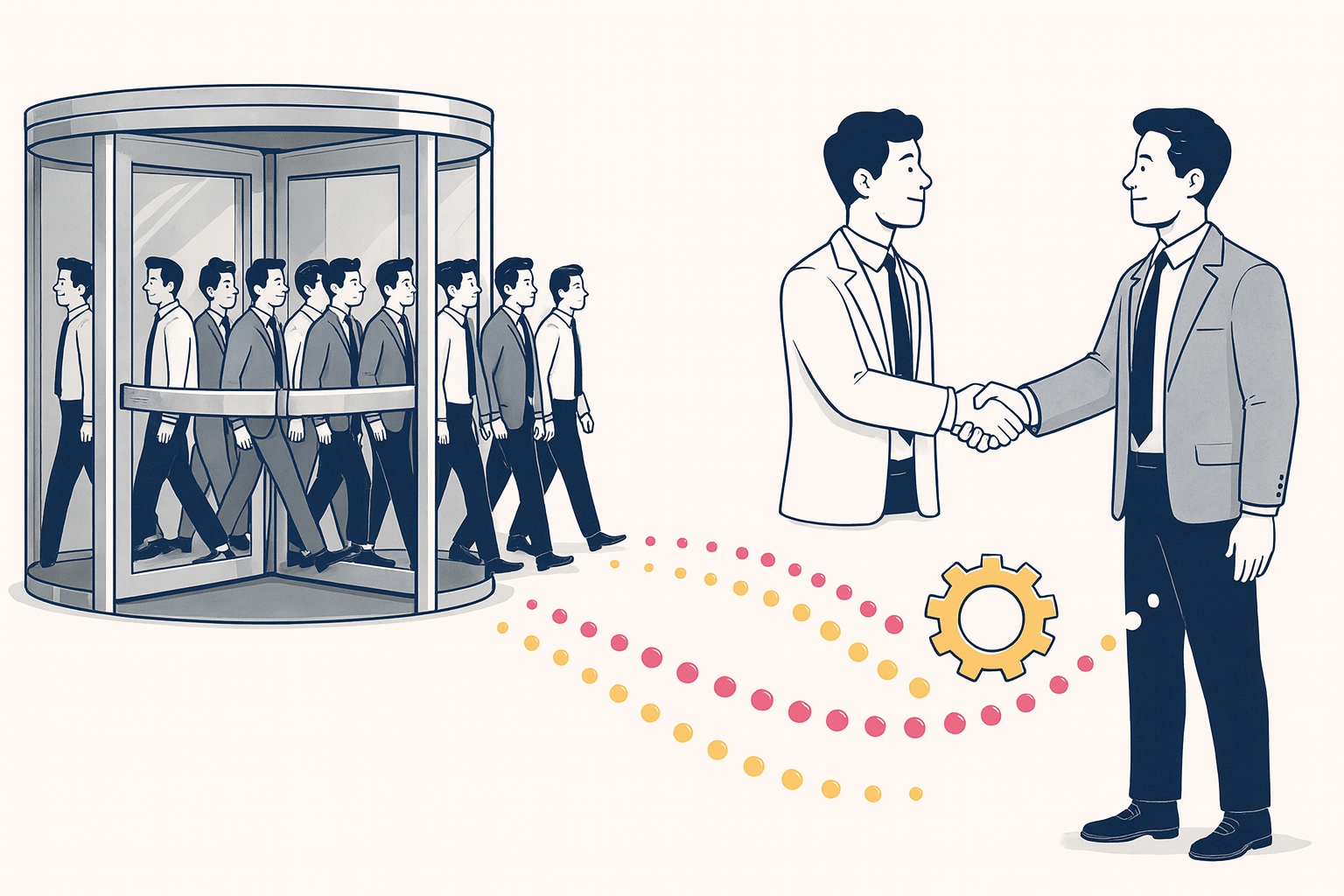
Hiring a fractional CMO: the two routes you are actually choosing between
When you decide you need senior marketing leadership without a full-time hire, the market gives you two shapes, and most buyers do not realize they are different products until they are mid-conversation. Route 1 is direct. You find one specific senior marketer, you interview them, you check their track record, and you bring them inside your team part-time. They own your pipeline number, your positioning, your team. If something is broken, there is one person whose name is on it.
Route 2 is through a company. You buy a subscription or a "productized" marketing service. You describe what you need, and the company sources or assigns an operator to you, often bundling junior executors or AI agents underneath, all billed as one flat monthly fee. The model started in design, where subscription studios like Designjoy turned bespoke creative work into a fixed monthly product, and it has spread into PPC, SEO, and now marketing leadership. Both routes are legitimate. They just answer the question "who is accountable, and for what?" in opposite ways. If you have not yet pinned down what a fractional CMO actually does day to day, settle that first, because the route only matters once the role is clear.
Is the productized version just a freelancer with nicer packaging?
This is the live debate, and you will find it argued in every fractional and marketing community on Reddit. The honest answer is: sometimes it is exactly that, and that is not automatically a problem. A one-person productized service is a single operator who has standardized their scope, pricing, and intake into a subscription instead of writing a custom proposal for every client. The work on the page is the same work a skilled freelancer would deliver. What you are paying the premium for is the packaging: fixed price, fast start, no back-and-forth on a statement of work.
So the useful test is not "freelancer or service." It is "is there anyone behind the one person?" If the productized service is one operator, you are hiring a freelancer with a tidier checkout, and you should evaluate them like one: seniority, track record, fit. If there is a real bench behind the brand, you are buying something different, with its own trade-offs further down this page.
The second recurring question is whether a monthly subscription is just a retainer wearing a better outfit. Mostly, yes. A subscription and a retainer both buy a fixed monthly amount of senior capacity. The subscription standardizes the scope and the intake so you skip the custom quote, and it often lets you pause or cancel month to month, which a traditional retainer rarely does. The economics sit close together. The packaging is the product. None of this makes the model a gimmick. It makes it a pricing-and-delivery wrapper, and a wrapper is worth paying for when it removes real friction. It is not worth paying for when it hides who is actually doing the work.
What you actually pay when a company sits in the middle
Here is the part buyers most often miss, and it is plain logic, not a conspiracy. Whenever an intermediary sits between you and the person doing the work, that operator does not lower their own rate. A senior marketer who commands a given day rate commands it whether you find them yourself or a service places them with you. So when you go through a company, you pay the operator's rate plus the company's margin. That is not a markup unique to marketing. It is the same cut an agency, a staffing firm, or any marketplace takes for sitting in the middle. The middle layer is a real service, and it is not free.
This is why the "what's cheaper" question has a clean answer for the same operator: direct removes the margin. The harder question is whether the margin buys you something you actually need, which is a fair trade more often than price-focused buyers admit. For the full breakdown of how day rates and monthly retainers are built, the fractional CMO cost guide walks through what drives the range. The table below is the structural comparison, not a price list.
| Dimension | Hiring direct | Through a productized company |
|---|---|---|
| Who you get | One specific person you chose and vetted | Whoever the company sources or assigns to your brief |
| What you pay for | The operator's rate, and nothing on top | The operator's rate plus the company's margin |
| Accountable for | Your revenue and marketing outcomes | The deliverables in the package scope |
| Continuity | Same person throughout the engagement | Operator can change; the company holds the relationship |
| Speed to start | Slower: you run the search and the vetting | Faster: intake and matching are the product |
| Vetting | You do it, with full visibility into the person | The company does it, with a bench to draw on |
| If your operator leaves | You are exposed and re-run the search | The company covers with someone else from the bench |
Control, accountability, continuity: where the routes genuinely diverge
Strip away the pricing and three things separate these models, and they are the things that decide whether the engagement works. Control. Direct means you pick the specific human in the room, not a profile that matches a brief. You can read their old work, talk to people who reported to them, and decide whether this person, not this category of person, can lead your function. The company route trades that for convenience: you describe a need and you get matched, which is faster but blinder.
Accountability. This is the sharpest difference. When you hire direct, the person is accountable for your numbers, the way an employee is, because there is nobody else to point at. When you hire through a company, accountability is usually framed around deliverables: the posts shipped, the pages built, the campaign launched. Deliverables are easier to measure and easier to hit while the actual business metric stays flat. A senior operator who owns your revenue outcome behaves differently from a service that owns a deliverables checklist, and you feel the gap most when something is not working.
Continuity. Direct means the same person who learned your market in month one is still in the room in month nine. Through a company, the operator can change, because the company, not the person, holds the relationship. That continuity is a feature when it protects you from a key-person risk, and a cost when the person who finally understood your business gets rotated off your account. None of this is hidden if you ask. Most buyers just do not ask until month four.
The case for the company route, made fairly
This is not a hit piece, and pretending the productized route has no upside would fail the only test that matters: is it true? It is not. The company route buys you four real things. Speed, because intake and matching are the entire product and a good service can have someone working inside a week. Vetting, because a credible firm has already filtered the bench you are choosing from, which is genuine labor you would otherwise do yourself. Depth, because a bench can flex specialists in for a specific job instead of stretching one generalist across everything. And cover, because if your operator gets sick, quits, or simply is not the right fit, the company swaps in a replacement instead of leaving you exposed mid-quarter.
For a founder who needs marketing leadership now, who does not have the network to source a senior operator, and who values a managed relationship over a personal one, that bundle is worth the margin. The mistake is not choosing the company route. The mistake is choosing it without knowing you are trading direct control and single-person accountability for it. Buy the trade on purpose, not by accident.
How to decide which route fits you
Run your situation against four questions and the answer usually falls out. One: do you know what you actually need, or do you need help defining it? If your problem is fuzzy, a managed service that helps shape the brief earns its place. If you know exactly what senior leadership you are missing, direct lets you hire for it precisely.
Two: how much does single-person accountability matter to this engagement? If you need someone to own a revenue number and stand behind it, direct is built for that. If you mainly need execution capacity managed for you, the company route fits. Three: how exposed are you to key-person risk? If losing one operator mid-quarter would hurt, the bench is insurance worth paying for. Four: do you have the network and the time to vet a senior hire yourself? If yes, you capture the margin by going direct. If no, you are paying the company to do work you genuinely cannot do well right now.
Once you know the route, the mechanics of finding and onboarding the person are the same either way, and the guide to hiring a fractional CMO covers the search, the trial period, and the first ninety days. If you want to see how the company comparison maps onto the broader options, the fractional CMO vs agency breakdown sits one level up from this one. And if you would rather talk it through against your specific situation, that is what a first call is for.
The productized route sells you a managed service. The direct route sells you a person who owns the result. Decide which one your situation actually needs, then pay for that on purpose.
Keep reading: Why a senior day rate costs you less · How to hire a fractional CMO · Fractional CMO vs marketing agency
Frequently asked questions
What is the difference between hiring a fractional CMO directly and through a company?
Hiring directly means you choose and vet one specific senior marketer, who works inside your team and is accountable for your numbers. Hiring through a productized or subscription service means you describe a need and the company sources or assigns an operator for you, billed as a flat monthly fee, with accountability usually framed around deliverables rather than revenue outcomes. Direct gives you a named person who owns the result; the company route gives you a managed service with a bench behind it.
Is a one-person productized marketing service just a freelancer?
Often, yes, with better packaging. A one-person productized service is a single operator who has standardized their scope, pricing, and intake into a flat monthly subscription instead of bespoke quotes. The work is the same as a skilled freelancer would do. What you are paying extra for is the packaging: fixed price, fast start, no negotiation. That can be worth it. Just know that when one person runs the productized service, you are hiring a freelancer with a tidier checkout, not a firm with depth behind them.
Is a monthly marketing subscription just a retainer with nicer packaging?
Mostly, yes. A subscription and a retainer both buy you a fixed monthly amount of senior marketing capacity. The subscription model standardizes scope and intake so the buyer skips the custom proposal, and it often lets you pause or cancel month to month. The economics are close to a retainer. The packaging is the product. The real question is not whether it is a retainer in disguise but whether the person doing the work is senior enough to own your strategy, and whether the same person stays on your account.
Which is cheaper, hiring a fractional CMO direct or through a company?
Direct is usually cheaper for the same operator. Whenever an intermediary sits between you and the person doing the work, the operator does not lower their own rate, so you pay their rate plus the intermediary's margin, the same way any agency or marketplace takes a cut. The company route can still be worth the margin when you are buying speed, vetting, bench depth, and cover if your operator leaves. But on price alone, paying the operator directly removes the middle layer.
Not sure which route your situation actually needs?
Every Focus4ward engagement starts with an audit, not a pitch. Two weeks to map where your marketing actually stands and what senior leadership it really needs, direct or otherwise. No pressure, just a clear read.
Book a call