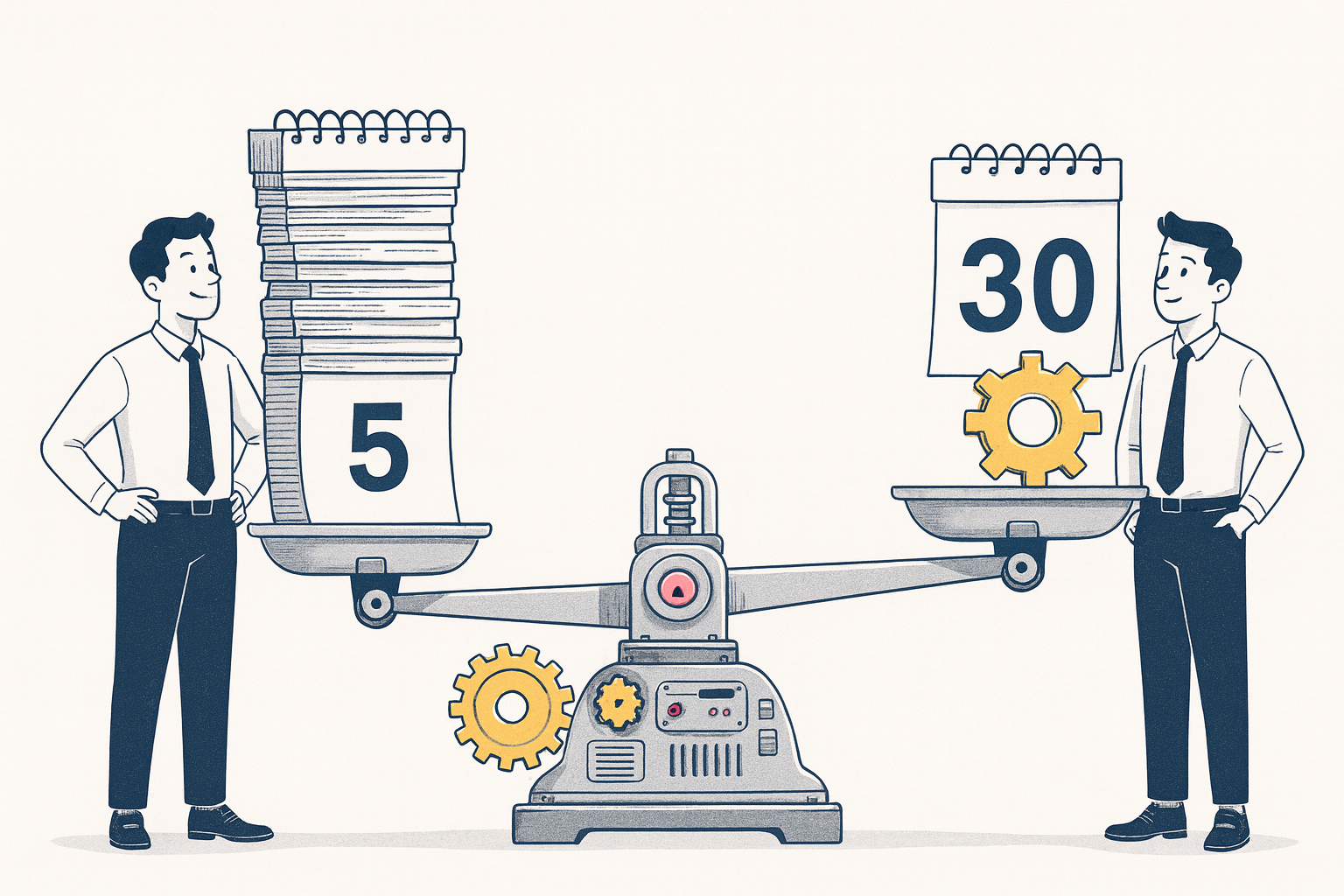
A fractional CMO day rate tells you what one day costs, not what the outcome costs. The senior operator at the higher rate does in one day what a less experienced one does in two or three, reaches a working result faster, and needs fewer days a month for the same job. So the higher rate often produces the lower total. Compare total cost and time-to-impact, not the headline number.
Fractional CMO day rate is the wrong number to compare
The market makes this easy to get wrong. Every fractional CMO quotes a day rate, the rates sit in a visible range, and the natural move is to line them up and pick the low one. That works for buying a commodity. It does not work for buying judgment.
Two operators can quote the same day rate and deliver wildly different value, because what you are actually buying is not a day. It is a result: a positioning that lands, a pipeline that moves, a team that knows what to do on Monday. The day is the unit you get billed in. It is not the thing you are paying for. The moment you treat the rate as the price of the outcome, you have already mispriced the decision.
There are two reasons the cheap rate so often turns out expensive. The first is about speed. The second is about who owns your number. Both compound.
Seniority is a different product, not a pricier version of the same one
A senior operator and a junior one are not the same service at two price points. They are two different products. The senior one has run the play before, across enough companies that your situation is rarely new to them. They recognize the pattern, skip the dead ends, and reach a working answer fast. That is what experience is: not knowing more, but knowing sooner.
This shows up in two places that both hit your invoice. A senior operator does in one focused day what a less experienced one stretches across two or three, because they are not learning your category on your time. And because they reach a result faster, they need fewer days a month to hold the function. Same job, fewer billed days, shorter runway to impact.
Run that forward. A lower day rate that needs more days, more weeks before anything moves, and more of your own time spent steering is not a discount. It is a higher bill stretched over a longer wait. The headline rate looks lower while the engagement total runs higher. For a fuller breakdown of how much a fractional CMO costs and what actually drives the range, the day-rate model is only the first input. The number of days is the one that moves the total.
The total-cost maths most founders skip
The comparison founders run is rate against rate. The comparison that matters is rate multiplied by days, plus the cost of the delay. Three inputs decide the real cost of a fractional engagement, and only one of them is the day rate.
The first is days per month. A senior operator who needs four days to do what a cheaper one needs eight has already closed most of the gap, even before you count the rate. The second is time to first result. Marketing leadership that takes two months to find its footing costs you two months of stalled pipeline on top of the fees. The third is your own time. A junior operator who needs constant direction is quietly billing you in founder hours that never appear on the invoice. Those hours are the most expensive in the company.
Put the three together and the picture inverts. The higher day rate, attached to fewer days, a faster result, and less of your attention, frequently lands at a lower total cost of ownership than the rate that looked cheap on the page. This is the same logic behind the fractional versus full-time CMO decision: the question is never the sticker price of the seat, it is what the seat actually costs you once you count everything it touches.
Accountability and continuity: who actually owns your number
The second reason runs alongside the first, and it is about ownership. When you hire a senior fractional CMO directly, one named person is accountable for your revenue outcomes. They own the number. They are in the room when it moves and in the room when it does not, and they are the same person from kickoff to handover. Continuity is not a feature you negotiate. It is the default.
Subscription and managed-team models are built differently. The accountability is typically framed around deliverables, the campaigns shipped, the assets produced, the cadence maintained, rather than around the revenue outcome itself. And the operator working on your account can change during the engagement, because the model is designed to assign capacity, not to embed a person. The work can be perfectly competent. What is thinner is ownership of the result and the continuity of someone who carries your context in their head.
This is the real fork. It is less about freelancer versus company and more about whether one accountable operator owns your outcome or a service owns a scope of work. I walk through that split in detail in hiring a fractional CMO direct or through a company. For founders, the question to hold onto is simple: when the number misses, who is accountable, and will it be the same person who promised it?
Day rate versus total cost, side by side
The same engagement, viewed through three routes. The headline rate is the only row where the cheap option wins. Every row after it is where the total cost is actually decided.
| What you compare | Senior operator, hired direct | Cheaper operator, hired direct | Subscription or managed team |
|---|---|---|---|
| Headline day rate | Higher | Lower | Bundled, often not itemized |
| Days billed for the same job | Fewer | More | Set by the plan, not the work |
| Time to first result | Fastest, runs on pattern memory | Slower, learning on your time | Varies with who is assigned |
| Your own time spent steering | Low | High | Medium |
| Who owns the revenue number | The named operator | The named operator | The deliverable, framed by scope |
| Same person throughout | Yes | Yes | Not guaranteed |
| Direction of total cost | Often lower despite the rate | Often higher once days add up | Hard to compare cleanly |
How to compare day rates without getting fooled
You do not need a spreadsheet to do this well. You need three questions, asked of every operator you are weighing, before the rate enters the conversation at all. They convert a rate comparison into a cost comparison.
How many days a month will this actually take? A senior operator will give you a tight number and explain what shrinks it over time. A vague answer, or one that grows the longer you talk, is your signal that the low rate is about to be multiplied. The day count is the lever, so make them name it. If you are still mapping what the role even covers, what a fractional CMO actually does is the place to calibrate scope before you price it.
When does the first real result land? Time to impact is a cost, even though it never shows up as a line item. Ask what moves in the first thirty days and what they will be held to. The operator who can answer specifically is the one who has done it before, which is exactly what you are paying the higher rate to get.
Who is accountable for the number, and is it always you? One name, owning the outcome, present throughout. That is the answer that protects continuity. Anything that routes accountability to a deliverable or leaves the operator interchangeable is buying you a service, not a leader. Sometimes a service is what you want. Just price it as the different product it is.
The French market has a clean word for the unit at the center of all this. The TJM, the Taux Journalier Moyen, is the standard day-rate metric for freelance and fractional operators, and it carries the same trap in both languages. A TJM tells you what a day costs. It tells you nothing about how many days, how fast, or who owns the result. Those are the numbers that decide what you actually pay.
The cheapest day rate is rarely the cheapest engagement. Count the days, count the weeks to impact, count whose name is on the number. Then compare.
Keep reading: Fractional CMO cost in 2026 · Hiring direct vs through a company · Fractional CMO vs full-time CMO
Frequently asked questions
Is a higher fractional CMO day rate worth it?
Often, yes. The day rate is the price of one day, not the price of the result. A senior operator does in one day what a less experienced one does in two or three, reaches a working result faster, and needs fewer days a month for the same job. So the higher rate frequently produces a lower total cost: fewer days billed plus a shorter time to impact. Compare total cost and time-to-result, not the headline number.
What is a TJM and how does it relate to a fractional CMO day rate?
TJM stands for Taux Journalier Moyen, the standard day-rate metric used by freelance and fractional operators in France. It is the same idea as a fractional CMO day rate: the cost of one day of work. The point holds in both languages. A TJM tells you what a day costs, not what the engagement costs, because the number of days and the speed to result are what move the total.
Does a cheaper fractional CMO cost more in total?
It can. A lower day rate usually buys less experience, and less experience tends to need more days for the same outcome and longer to reach a result. Once you multiply the rate by the extra days and add the cost of the delay, the cheaper operator can end up more expensive. The headline rate looks lower while the engagement total runs higher.
How is accountability different with a subscription fractional CMO service?
A fractional CMO you hire directly is accountable for your revenue outcomes and is the same person from kickoff to handover. A subscription or managed-team service typically frames accountability around deliverables rather than the number, and the operator assigned to you may change during the engagement. The work can still be good, but ownership of the result and continuity of the relationship are weaker.
Not sure which day rate actually costs you less?
Every Focus4ward engagement opens with an audit. Two weeks to map what your marketing function really needs, how many senior days it takes, and what the total cost looks like next to the headline rate. No pitch, no pressure.
Book a call