Marketing automation vs AI marketing systems, defined
Marketing automation is workflow software that executes a predetermined sequence. A lead fills a form, the system tags the record, sends the third email in the drip on schedule, and pings sales after the fifth open. Nothing in that chain evaluates the lead's actual situation. It is a flowchart, run reliably, forever the same regardless of the buyer, the market, or what the previous email actually said. That is most of what Zapier, Marketo, and HubSpot's workflow builder have done since the 2010s, and it still runs the majority of B2B lead handling today.
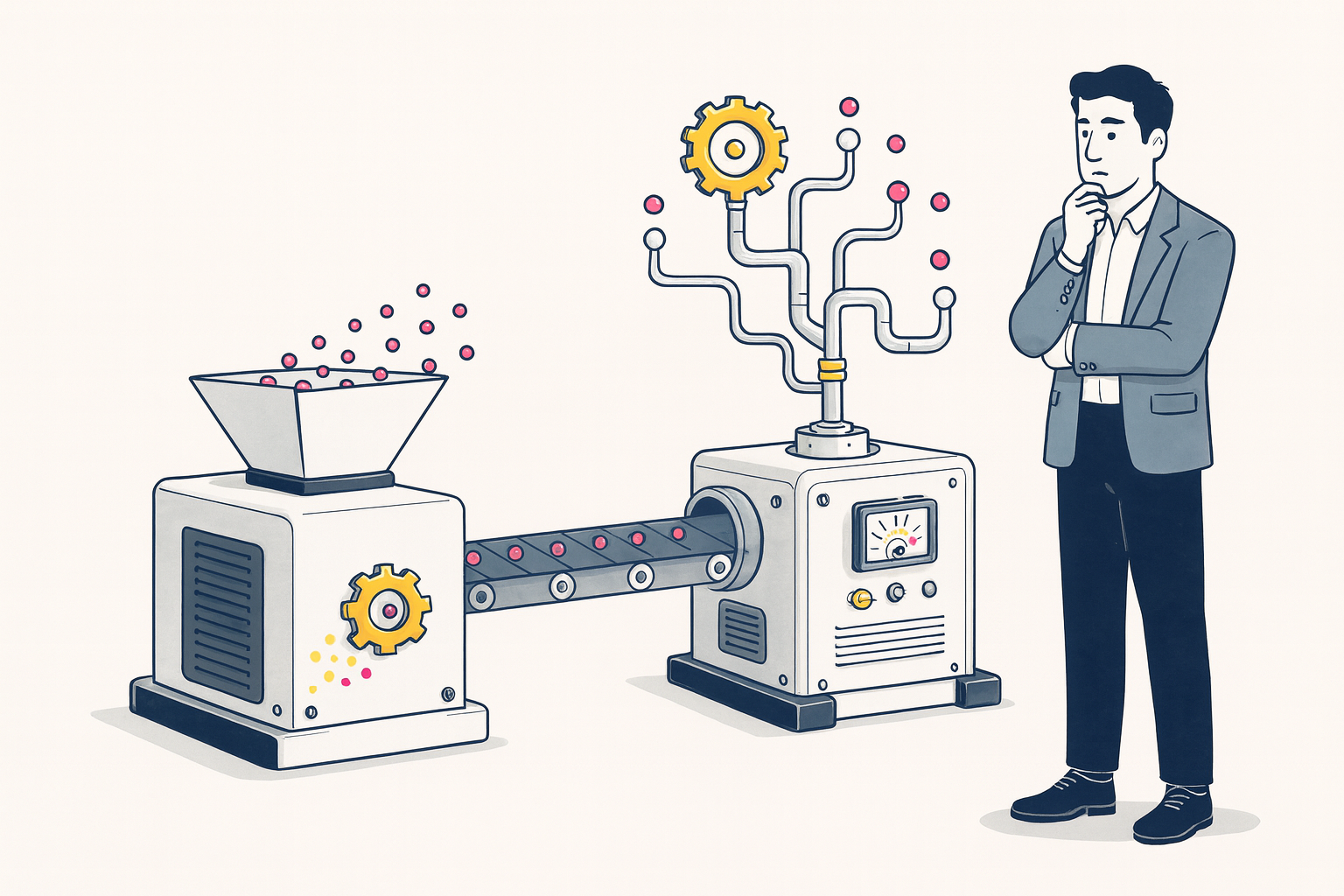
An AI marketing system replaces the fixed rule with a reasoning step. Instead of "if opened, then send," the system reads the lead's firmographic data, the content they engaged with, and the account's deal stage, then decides what the next action should be, and that decision can differ for two leads who triggered the identical event. The system can be wrong. It can also handle a case nobody wrote a rule for, which a rules engine cannot do by definition. That single capability, handling the unscripted case, is the entire difference this article is about.
Marketing automation vs AI marketing systems, side by side
Six dimensions make the mechanical gap concrete. Notably, the gap is not about which tool has a nicer interface. It is about where the decision gets made, and when.
| Dimension | Marketing automation | AI marketing system |
|---|---|---|
| Decision logic | Pre-written rule, if this then that | Model evaluates context each time it runs |
| Handles a case nobody scripted | Fails silently or does nothing | Attempts a response, ideally inside a review gate |
| Improves as data accumulates | No. The rule stays fixed until a human edits it | Only if the review loop feeds corrections back in |
| What breaks it | An edge case nobody anticipated at build time | A gap in the data it needs in order to reason |
| Where the judgment sits | Written once, by a human, in advance | Made at run time, by the model, inside guardrails a human set |
| Typical example | Drip sequence, fixed-point lead scoring | Account brief that reads the CRM, recent emails, and news, then flags the one thing sales should say next |
Why most "AI marketing" tools are still automation
The label is doing more work than the product. In March 2024, the U.S. Securities and Exchange Commission charged two investment advisers, Delphia and Global Predictions, with what it called "AI washing": telling clients their products used artificial intelligence in ways they did not. Marketing software has the same incentive to over-claim, without the same regulator watching it. A platform can bolt a chatbot onto an unchanged rules engine and market the whole thing as "AI-powered" without a single decision in the actual pipeline being made by a model.
Gartner draws the practical line at agency: whether a system can evaluate a situation and act toward a goal, not only generate text in response to a prompt. Gartner's March 2025 forecast on agentic AI put a number on how far the market still has to go: it predicts that by 2028, agentic AI will feature in a third of enterprise software applications, up from under 1% in 2024. That gap, under 1% to a third, is a testament to how much of what currently ships as "AI marketing" is chat-wrapped automation, not reasoning.
What a reasoning system actually changes for a marketing team
Take lead scoring. A rules-based platform scores a lead by adding fixed points for a fixed list of actions: ten for a whitepaper download, twenty for a webinar attendance, minus five for a bounced email. That scoring model has not changed since whoever configured it left the company two years ago. An AI marketing system instead reads the account's full activity history, company size, and the specific pages visited, and produces a recommendation with the reasoning attached: this account visited the pricing page twice in one week, and the champion changed jobs six weeks ago, flag it now. Nobody wrote a rule for "champion changed jobs." The system found it because it read the LinkedIn change and the CRM record together, in context, at the moment it mattered.
The same shift shows up in content operations and competitive monitoring, the two workflows most lean B2B teams reach for first when they start building an AI marketing stack for a lean team. A rules-based content calendar publishes on schedule regardless of what a competitor shipped that week. A reasoning layer reads the competitor's announcement, checks it against the existing content plan, and flags the one piece that needs rewriting before it goes out stale.
How to tell which one you're actually running
Three questions settle it faster than any vendor deck. First: if you feed the system an input the builder never anticipated, does it attempt an answer, or does it do nothing? Second: does the system's output change when the underlying situation changes, or only when a human edits the rule? Third: is there a review gate where a person can see and correct the reasoning, or is the "AI" label sitting on top of a static score nobody has looked at since it launched?
A tool that fails all three is automation, whatever the pricing page calls it. A tool that passes even one is doing something a flowchart cannot.
Where automation still wins
None of this makes automation obsolete, and treating it that way is its own budget mistake. A reasoning system costs more to run, needs a review gate a human actually staffs, and can produce a confident, wrong answer in a way a rule never will, because a rule has no confidence to be wrong about. For workflows where the logic genuinely never changes, onboarding sequences, tagging, reminder cadences, automation remains the cheaper, more reliable choice. Reserve reasoning for the judgment calls current staff no longer have time for: lead prioritization, first-draft content briefs, competitive monitoring. Automation for the routine. Reasoning for the judgment. Most stacks need both, running side by side, not one replacing the other.
The tool doesn't decide which one you're running. The decision does. If nobody wrote the rule and the system still knew what to do, that's an AI marketing system. If a human wrote it three years ago and nothing has changed since, that's automation with better branding.
Keep reading: What is an AI marketing system? · AI marketing stack for lean teams · AI marketing systems for B2B
Frequently asked questions
What's the actual difference between marketing automation and an AI marketing system?
Marketing automation executes a rule someone wrote in advance: if a lead does X, the system always does Y, regardless of context. An AI marketing system runs a model that evaluates the specific situation, the account, the content, the timing, and decides what to do at the moment it runs. The practical test: change one variable the builder never anticipated. Automation breaks or does nothing. A reasoning system attempts an answer.
Is HubSpot or Marketo an AI marketing system?
Mostly not, even where the interface says "AI-powered." The core of both platforms is a workflow engine: pre-written triggers and actions. Recent AI features (content assistants, predictive lead scoring) add a reasoning layer on top of that engine, but the sequencing underneath is still fixed rules. Whether a specific feature counts as a genuine AI marketing system depends on whether it evaluates context at the moment it runs or applies a score calculated once and left static.
How do I know if a vendor's "AI" feature is actually AI washing?
Ask what changes about the output when you give it an input the vendor's team never anticipated. If the honest answer is "nothing, it still follows the same rule," that is automation with an AI label on the box. The U.S. Securities and Exchange Commission charged two investment advisers with exactly this in March 2024, misrepresenting how much AI actually sat inside their product. Marketing software has the same incentive to over-claim, without the same regulator watching.
Should a lean marketing team replace its automation stack with AI marketing systems?
No. Layer, don't replace. Keep automation for the sequences that genuinely never change: onboarding emails, tagging, reminders. Add a reasoning system where judgment currently sits with one overloaded person: lead prioritization, first-draft content briefs, competitive monitoring. Replacing a cheap, reliable rule with an expensive model that does the same fixed job is the most common AI-budget mistake lean teams make.
Not sure which one is actually running in your stack?
Every Focus4ward engagement starts with an audit. Two weeks to map what's genuinely reasoning, what's automation with a label, and where a reasoning layer would earn its cost fastest. No pitch, no pressure.
Book a call