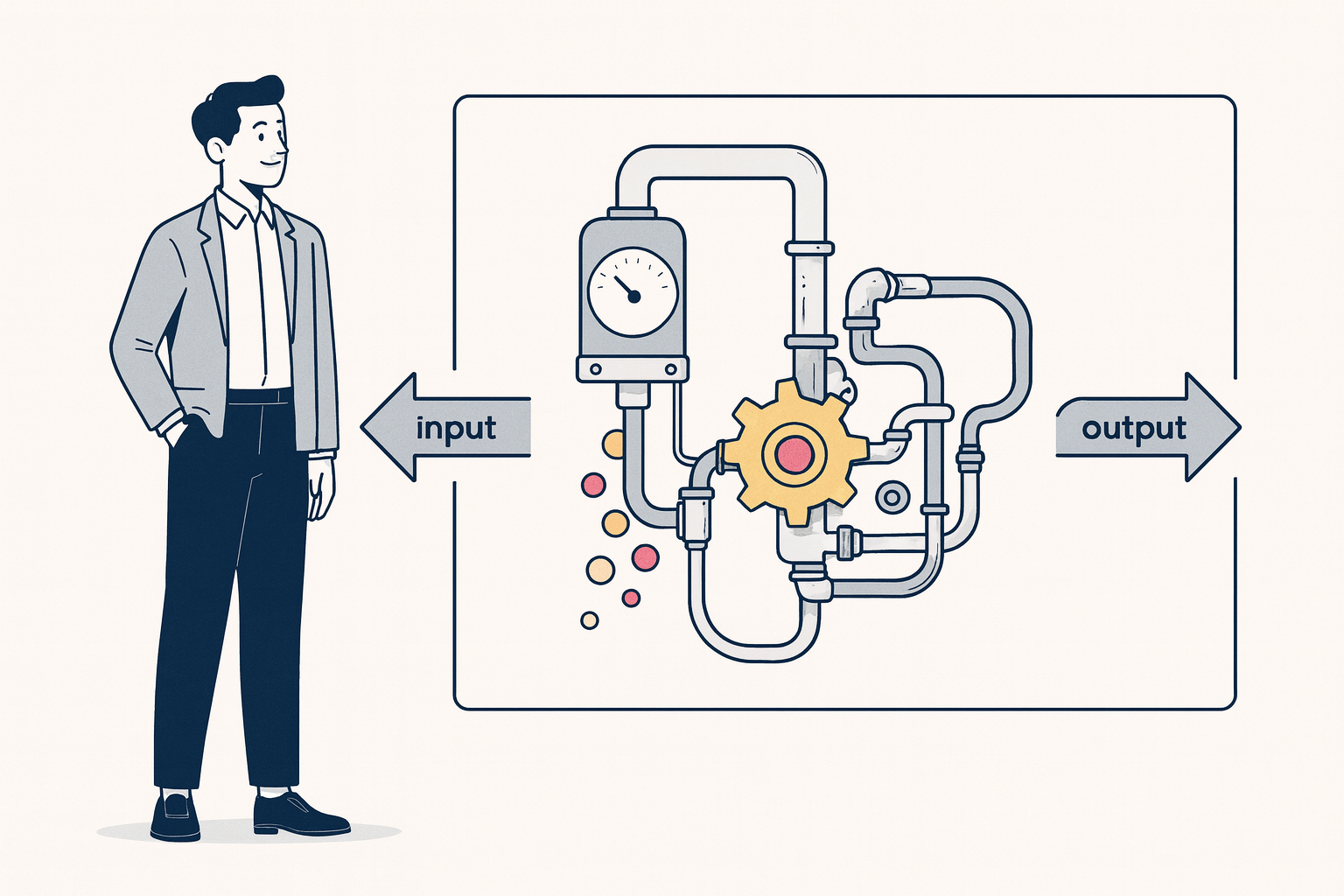
An AI marketing system is a connected set of workflows, built around data, workflow logic, a model, a review gate, and an output loop, that takes a marketing job from input to finished output with a human owning the judgment call. It is not a single AI tool, and it is not a single automated feature living inside a bigger platform. Per Forrester's 2024 B2B Buyers' Journey research, 89% of B2B buyers now use generative AI somewhere in their purchase process, which means the practical question for a marketing leader is no longer whether to use AI. It is whether what is running on your team is a system, or three disconnected tools wearing a system's name.
What is an AI marketing system, exactly?
Strip the term down and it means this: a repeatable pipeline that carries a piece of marketing work from a brief to a finished, checked output, with AI doing the heavy lifting on the parts that pattern-match and a human doing the parts that require judgment. The system is the plumbing and the rules, not the model. The model is replaceable. The architecture around it is the asset.
That distinction matters because most teams describe their AI setup as a "system" when what they actually have is a browser tab someone remembers to open. A real system runs whether or not the person who built it is in the room that day. If a workflow only works because one person on the team knows the right prompt, it is not a system yet. It is a habit.
Tool, feature, or system: the difference that actually matters
Three words get used interchangeably in most vendor decks, and the confusion costs marketing leaders real budget. A feature is a capability switched on inside software you already pay for. A tool is a standalone product a person opens and prompts. A system is the architecture that connects several steps, tools included, into one job that runs with far less manual handling. None of the three is inherently better. The mistake is buying one and expecting the outcomes of another.
| Dimension | Feature | Tool | System |
|---|---|---|---|
| What it is | An AI capability switched on inside a platform you already own | A standalone product a person opens and prompts directly | Connected workflow logic, data, a model, and a review gate running as one job |
| What triggers it | A button click inside existing software | A person remembering to open it and write a prompt | A brief, a trigger, or a schedule, with no manual prompting required |
| Where judgment sits | Wherever the vendor decided, often invisible to you | Entirely with the person prompting it, every single time | Automated on routine steps, routed to a human at a defined review gate |
| What happens at scale | Scales as far as the vendor's roadmap allows, no further | Does not scale. More volume means more people prompting more tabs | Scales because the steps and the checks are already built in |
| Example | An "AI subject line suggestion" inside your email platform | A marketer pasting a brief into ChatGPT and copying the draft out | A workflow that pulls the brief, drafts in your voice, checks it against your rules, and routes it to an editor |
Notably, a company can own all three at once and still have no system, because a feature and a tool are things you use, while a system is something you build. The rule Focus4ward runs by is the same one worth borrowing here: build the system once, let it run. A feature you switch on and a tool you open both ask for your attention again tomorrow. A system asks for your attention once, at the review gate, and then keeps running.
AI marketing system vs marketing automation: not the same thing
The two get confused because both promise "less manual work," but they solve different problems. Marketing automation executes a rule someone already decided: if a visitor downloads this asset, send that email three days later. It is deterministic. Feed it the same trigger a thousand times and it does the identical thing a thousand times, because there is no judgment involved, only a path someone mapped in advance.
An AI marketing system handles ambiguity. It reads context that changes from job to job, drafts something original rather than selecting from a fixed set of templates, and flags what it is unsure about for a human to decide. Automation scales a decision that has already been made. An AI marketing system helps make the decision in the first place, then hands the routine parts of executing it to the model. For the fuller comparison, including where the two overlap and where a hybrid setup makes sense, see AI marketing system vs marketing automation.
The five pieces every AI marketing system needs
Whatever the use case, a working AI marketing system carries the same five components. Data and context, so the output reflects your positioning and not a generic version of your category. Workflow logic, the ordered steps and branches that turn a one-shot prompt into a repeatable job. The model itself, which is the swappable part and matters less to the architecture than most conversations assume. A review gate, the checkpoint where a human decides what ships. And an output loop, where the work lands and where results feed back to make the next run sharper. Miss one of the five and the system either does not run, or runs and cannot be trusted. For the full breakdown of each component and the build-versus-buy decision behind them, see AI marketing systems for B2B.
The value does not stop at marketing
A system built for marketing rarely stays a marketing asset. The same architecture that drafts a blog post in your voice can brief a sales rep before a call: pull the account's context, the last three touchpoints, and what the prospect actually read on your site, and hand the rep a one-page brief instead of twenty minutes of tab archaeology. Follow-up emails after the call, proposal first drafts, competitive one-pagers for a deal in play: all of it is the same five components pointed at a different job.
This is the strongest argument for building the first system in marketing rather than buying one department-sized AI tool per team. Marketing already owns the positioning, the messaging, and most of the company's reusable content, so the data-and-context layer built for marketing is exactly the layer sales, customer success, and even recruiting want to borrow. Build the foundation once, where the content lives. Every team after that plugs into an asset instead of starting from zero.
Signs you have a tool problem, not a system
A handful of patterns show up reliably on teams still at the tool stage. The same brief gets drafted from scratch every time, because nothing persists between runs. Two people on the team get two very different results from the same AI tool, because the quality lives in whoever is prompting, not in the workflow. Nobody can point to where a given piece of work "lives," because it exists as a chat history, not a process. And the AI licence gets renewed every year on faith that it is saving time somewhere, without anyone measuring where.
None of these are AI problems. They are architecture problems, and the fix is not a bigger AI budget. It is choosing one repeatable, high-volume workflow and building the five components around it once, so it runs the same way whether or not the person who built it is watching.
A tool does the work when you ask it to. A system does the work because you already decided how. Build it once. Let it run.
Keep reading: AI marketing systems for B2B · AI marketing system vs marketing automation · The AI maturity ladder
Frequently asked questions
What is an AI marketing system?
An AI marketing system is a connected set of workflows, built around data, workflow logic, a model, a review gate, and an output loop, that takes a marketing job from input to finished output with a human owning the judgment call. It is not a single AI tool and not a single automated feature. It is the architecture that sits around the model and makes its output repeatable, checked, and reusable.
What's the difference between an AI marketing tool and an AI marketing system?
A tool does one task when a person opens it and prompts it. A system connects several steps, including the tool, so a whole job runs with far less manual handling. A ChatGPT tab open in a browser is a tool. A workflow that pulls a content brief, drafts against your positioning, checks it against your brand rules, and routes it to an editor is a system. Most B2B teams have accumulated tools and call the collection a system.
What's the difference between an AI marketing system and marketing automation?
Marketing automation runs a fixed rule: if this trigger fires, send that email. It does not decide anything; it executes a path someone already defined. An AI marketing system handles ambiguity: it reads context, drafts original content or makes a judgment call, and flags what it is unsure about for a human to decide. Automation scales a decision you already made. An AI marketing system helps make the decision in the first place.
How do I know if my company needs an AI marketing system rather than more tools?
The signal is repetition without leverage. If the same brief gets rebuilt from scratch every time, if every person on the team gets a different result from the same AI tool, or if nobody can point to where a workflow actually lives, the team has tools, not a system. The fix is not a bigger AI budget. It is picking one repeatable, high-volume workflow and building the architecture, data, logic, model, review gate, and loop, around it once.
Not sure whether your team has a system or a stack of tools?
Every Focus4ward engagement starts with an audit. Two weeks to map what is actually running, what is repeatable, and the one or two systems worth building first. A diagnostic, not a pitch.
Book a call