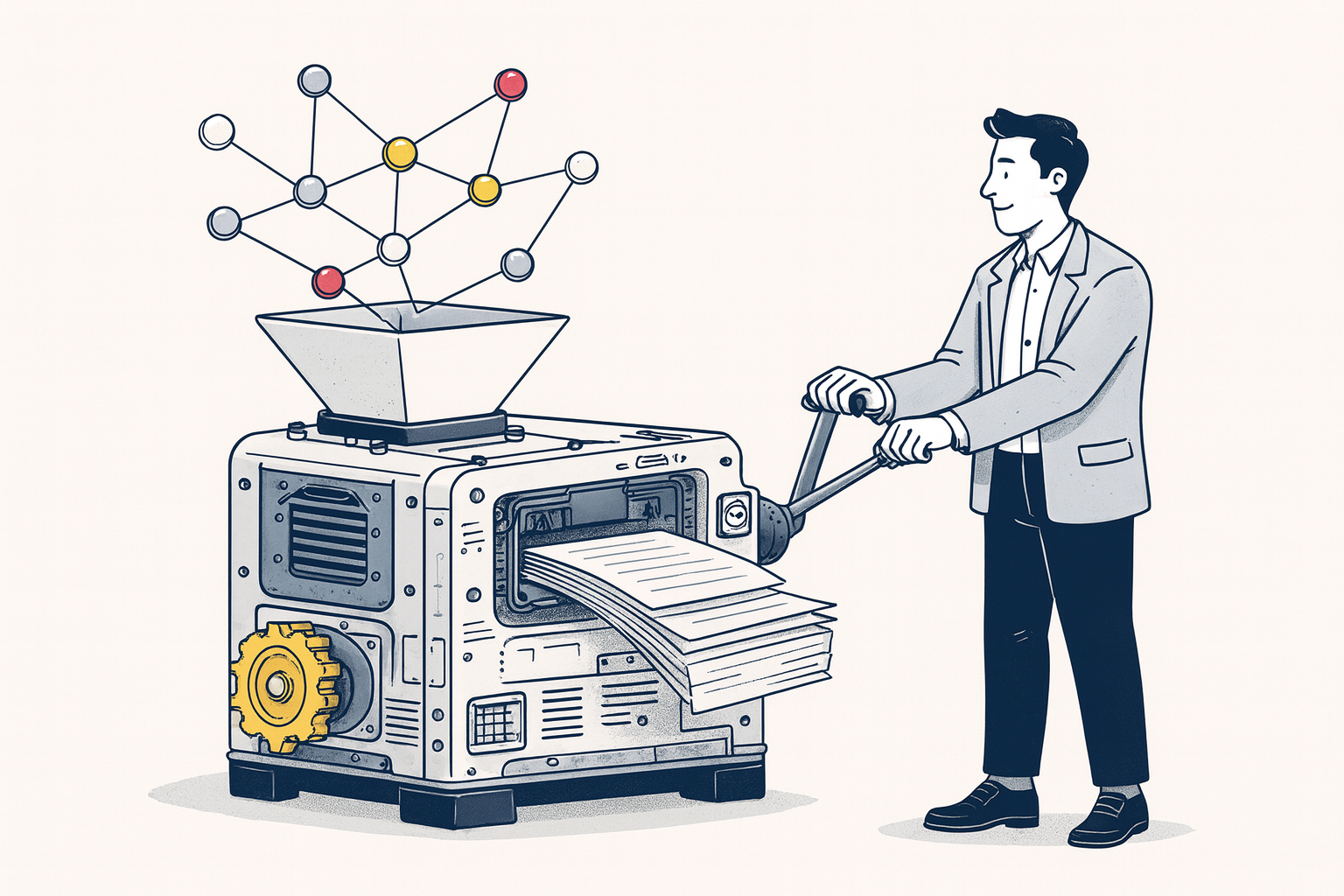
What an AI content engine actually is
An AI content engine is not a chat window a writer prompts once per article. It is a pipeline: a topic-cluster roadmap feeds a brief (keyword, buyer stage, persona, internal links) into a generation step constrained by a locked voice and a strict register, the output picks up full schema markup automatically, a human reviews it before it ships, and the piece deploys through the same path every time. The engine produces a system that compounds. A prompt-to-publish tool produces one draft, once.
The distinction matters because most "AI content" strategies stop at generation. They get faster writing and the same weak architecture underneath it, which is why so much AI-assisted content still under-performs. Speed was never the bottleneck. Structure was.
Why most AI content doesn't get cited
An analysis of 1.2 million ChatGPT responses, published by Growth Memo on LinkedIn, found that AI citation behaviour is heavily consolidated: the top 30 domains for a given topic capture roughly 67% of citations, and the top 10 alone capture 46%. Inside that data, 58% of cited URLs appear in only one prompt and then never again, while the top 5% of pages each answer 10 or more unique prompts. Single-keyword pages get cited once and vanish, regardless of who or what wrote them.
That is the tell. A content engine built to publish more single-intent posts, faster, is optimizing for the wrong shape. The pages that keep getting cited are broad enough that an AI engine treats them as the canonical answer for a cluster of related questions, not for one query.
The five parts of a content engine that ranks
Five components, in the order they run. Miss the middle two and volume alone won't fix it.
1. A topic-cluster roadmap, not a content calendar
Every brief is assigned a primary keyword, a cluster it belongs to, a buyer-journey stage (problem-first, comparison, proof, or implementation), a named persona, and the specific internal links it needs to carry before a single word gets generated. This is what this article's own brief looked like before this sentence existed: cluster ai-marketing-systems, stage HOW, persona CMO, with links back to Focus4ward's GEO explainer and its AI-marketing-systems pillar guide already assigned.
2. Generation locked to a voice and a register
The model writing the draft is constrained by a fixed voice specification and an explicit rule for what it cannot do: invent a personal anecdote it never lived, or state a number without a named, checkable source attached. Answer pages built this way earn authority from framework clarity, not from borrowed war stories.
3. Schema markup as a required step, not an afterthought
Generative AI systems read the full vocabulary of Schema.org, not only the handful of types that trigger a rich SERP result. Every article carries BlogPosting with a full author entity, FAQPage matching the visible FAQ, and BreadcrumbList, generated at the same step as the body copy, not bolted on before publish.
4. A human review gate before anything goes live
Every draft ships as a pull request, not a live page. A person checks that each statistic carries a source they would defend out loud, that the voice reads like a person and not a template, and that the page could be quoted by a neutral third party as evidence, not read as a pitch. Nothing publishes without that sign-off.
5. One deploy path and one measurement loop
Approved pieces push through the same route every time: sitemap updated, llms.txt updated when a new named topic appears, live within minutes. After that, the engine's job is done and the measurement job starts, tracked the same way across every page it ships (see the section below).
An AI content engine vs the alternatives
How the four common approaches actually compare, dimension by dimension.
| Dimension | Manual blogging | Generic AI writing tool | Content agency retainer | AI content engine |
|---|---|---|---|---|
| Topic architecture | Ad hoc, one post at a time | One prompt, one post | Calendar, rarely cluster-mapped | Cluster-mapped roadmap, every brief |
| Schema markup | Usually missing or partial | Rarely included | Depends on the agency | Mandatory, every page |
| Voice consistency | Consistent, slow to scale | Generic unless heavily edited | Consistent, if one writer stays | Locked spec, scales without drift |
| Human review before publish | Author is the reviewer | Often skipped for speed | Yes, but adds days | Built into the pipeline as a gate, not a delay |
| Cadence at scale | Low, bound by writer time | High, but low quality control | Medium, bound by retainer hours | High, with quality control intact |
| Cost shape | One person's time | Subscription, low per-piece cost | Recurring retainer fee | Build cost once, marginal cost per piece is low |
Where the human has to stay
The review gate is the part it would be easiest to cut for speed, and the part that cannot go. What gets checked there: every sourced statistic gets traced back to a name, a study, and a date, not left as a plausible-sounding number. The voice gets read out loud for whether it sounds like a person or a template stitching together the right words. And the structure gets checked against a simple test: could this page be quoted by a neutral third party as a factual reference? If it reads like a persuasion arc instead of a piece of evidence, it goes back for a rewrite before it goes back to the reader.
None of that is optional, and none of it happens automatically once the model finishes writing. It is important to note that the gate is what makes the rest of the engine defensible. Cut it, and the engine ships confidently wrong content at scale instead of correct content at scale.
How to know if it's working
Track citation share, not just traffic. Query 20 to 50 buyer-intent prompts across ChatGPT, Perplexity, and Gemini monthly, and count how often a brand or URL gets named. Pair that with AI-referred conversion in analytics, filtered by referrer: Webflow's own data shows AI-referred conversion running roughly 6x higher than non-branded organic traffic, because AI-referred visitors arrive further into the decision already, with the brand pre-framed by the answer they just read. And watch prompt coverage per page: a page answering 10 or more distinct buyer questions is doing what the top 5% of cited pages do; a page answering one is a candidate for merging into a broader hub.
An AI content engine is not proof that a company writes fast. It is proof that a company can be trusted to check its own work before it ships. Build the checking in, or don't call it an engine.
Keep reading: Citation is the new ranking · AI marketing systems for B2B · What is generative engine optimization (GEO)?
Frequently asked questions
What is an AI content engine?
An AI content engine is a repeatable pipeline that turns a content brief into a published, schema-marked, on-brand page, with a human checkpoint before anything goes live. It is not a chat window a writer prompts one article at a time. The engine runs on a topic-cluster roadmap, a locked voice and register, mandatory schema markup, and a review gate, then ships through the same deploy and measurement loop every time.
Is AI-generated content actually cited by AI answer engines?
Sometimes, and the deciding factor is architecture, not the fact that AI wrote it. An analysis of 1.2 million ChatGPT responses (published by Growth Memo on LinkedIn) found that 58% of cited URLs appear in only one prompt and then never again, while the top 5% of cited pages each answer 10 or more unique prompts. Single-keyword pages, whether written by a human or a model, rarely get cited more than once. Broad topic-cluster pages with real schema markup are what earns repeat citation.
Does an AI content engine still need a human editor?
Yes, at a specific and non-negotiable checkpoint: before publish, not after. The review gate is where a human checks that every statistic on the page carries a source they can defend, that the voice sounds like a person rather than a template, and that the structure holds up as evidence rather than a sales pitch. Removing that gate to publish faster is the single fastest way an AI content engine starts shipping content nobody will stand behind.
What's the difference between an AI content engine and a generic AI writing tool?
A generic AI writing tool turns one prompt into one draft. A content engine turns a topic-cluster roadmap into a pipeline: each brief is pre-assigned a keyword, a buyer stage, a persona, and a set of internal links before generation starts, every output gets full schema markup and a pre-publish checklist, and every piece routes through a human review gate before it deploys. The tool produces text. The engine produces a system that compounds, because each new page is built to reinforce the cluster around it instead of standing alone.
Want a content engine like this one running for your own site?
Every Focus4ward AI Systems Build ships with a topic-cluster roadmap, full schema, a locked voice layer, and a review gate before anything goes live. Two to four weeks, handed over with training.
Book a call